Missouri household history
From Feather Ticks to Organic Cotton: How Sleep Materials Changed Over Time
A bed is more than a place to sleep. Its layers tell stories about labor, trade, technology, household budgets, and changing ideas of comfort. Across Missouri, the materials beneath the sheets have shifted from feathers and handwoven cloth to factory-made fabrics and contemporary natural fibers—each change reflecting a wider transformation in home life.
Published November 4, 2026
Reading history in the bed
In a historic house, a bed can appear almost still: a wooden frame, a quilt folded at its foot, a pillow set squarely against the headboard. But the objects that made sleep possible were never static. They were assembled from materials that had to be grown, raised, gathered, processed, traded, stitched, stuffed, cleaned, and repaired. A mattress was not simply purchased and discarded. It might be filled, emptied, aired, patched, and passed from one household generation to another.
That history is especially revealing in Missouri, where farms, river towns, expanding cities, and changing transportation networks brought different household economies into contact. The contents of a bed might reflect what a family could produce locally, what it could afford to buy, and what merchants could bring to a nearby store. Surviving furnishings and household records can offer clues, though they rarely tell the whole story. A bedstead may remain after its original mattress has vanished; an inventory may list “bed and bedding” without specifying the fibers inside.
To trace the evolution of sleep materials, it helps to look beneath the visible cover. The ticking—the closely woven fabric enclosing a mattress—was a practical barrier between the sleeper and its filling. Inside might be feathers, straw, wool, cotton, or other materials. Above it came sheets, blankets, coverlets, and quilts, each with its own history of making and use. The familiar modern mattress is therefore not one object so much as a layered system, redesigned again and again as materials and expectations changed.
Feather ticks and the work of keeping a bed
The phrase “feather tick” evokes a particular kind of domestic labor. Feathers were enclosed in a tightly woven ticking to make a soft, yielding mattress or pillow. Depending on what a household could obtain, fillings might include down, smaller feathers, or a mixture. The casing needed to be dense enough to limit escaping quills and fine material, while seams had to hold against years of movement and handling.
Feathers could be gathered from poultry raised for household use, acquired through local exchange, or purchased. Their presence in bedding did not mean that every bed was equally comfortable or equally well supplied. Filling a mattress required considerable material, and a household might collect feathers over time. The finished bed represented more than a purchase: it embodied repeated work and the value placed on conserving useful things.
Feather bedding also needed care. A mattress could be aired to release dampness and refresh its contents. Over time, filling could settle or shift, and the ticking might need mending. In some households, a mattress could be opened so that its contents could be cleaned, redistributed, or replaced. Such practices remind us that bedding once demanded a routine of maintenance that modern consumers may seldom encounter.
The term “ticking” eventually became associated with a recognizable striped fabric, but the essential idea was functional: a durable cover for a resilient filling. A mattress’s usefulness depended on the quality of both. A sound casing could contain its contents; a suitable filling could cushion the body and provide insulation from the bed frame and the room’s chill. The design was simple in outline but deeply dependent on material skill.
Missouri homes, local materials, and regional exchange
Missouri’s household history cannot be reduced to a single pattern. The state’s landscapes and communities differ, and so did the resources, income, and customs available to families. Rural households often had closer access to agricultural materials and the work of making or repairing domestic goods. In towns and cities, stores and manufacturers increasingly connected residents to a larger marketplace. River commerce, rail lines, roads, and industrial growth changed what could be transported and how reliably it reached local consumers.
Those connections matter when considering bedding. Cotton, for example, had to be cultivated, ginned, spun, woven, and distributed before it became cloth. Wool depended on sheep raising and processing. Feathers were tied to poultry keeping and trade. Even a seemingly ordinary sheet or mattress cover could embody work performed far beyond the room where it was used. Missouri’s place within national systems of agriculture and commerce helped shape what households could find, but local finances and habits shaped what they actually chose.
In family records, bedding may appear as a practical asset rather than a subject of special attention. An estate inventory might record bed furniture, blankets, or quilts among other household goods. A quilt preserved by descendants can reveal careful stitching, fabric reuse, and the value of cloth. But these sources require caution: an inventory’s brief wording cannot always identify a material, and a surviving object may have been altered or repaired long after it was first made.
For researchers, the most useful approach is to combine evidence. Household inventories, newspapers, store records, family letters, photographs, museum collections, and surviving textiles can illuminate different parts of the story. A photograph may show the frame and bed coverings but not the mattress filling. A written record may name an item but offer no detail about its construction. Read together, these fragments help place everyday sleep within the larger history of Missouri homes.
From household craft to manufactured bedding
As manufacturing expanded and transportation improved, bedding became increasingly available as a standardized product. Mechanized textile production made cloth more widely obtainable, while specialized businesses developed ways to make and sell mattresses at greater scale. The change was gradual and uneven. Home production did not disappear all at once, and purchased goods did not immediately become affordable to everyone. Still, a growing marketplace altered the balance between making a bed at home and buying its components.
Factory production brought consistency and choice. Consumers could select among different mattress constructions and coverings instead of relying entirely on materials gathered or made within the household. The growth of commercial bedding also encouraged new ideas about comfort: a bed could be judged by its firmness, resilience, size, or supposed suitability for particular needs. Advertising helped turn sleep into a product category, while household magazines and retail displays presented new standards of domestic convenience.
These developments changed the meaning of maintenance. A hand-filled mattress could be opened and renewed; a factory-made mattress might be treated as a finished unit. Some were designed to last, but the market increasingly offered replacements and variations. Families still repaired linens and reused textiles, yet the broader culture of buying household goods began to move toward more specialized products.
The evolution was not a straight line from hardship to comfort. Manufactured goods could be more accessible, but they also depended on supply chains and production choices that were less visible to the buyer. A product’s label might tell a purchaser something about its materials, but the origins of those materials, the conditions of production, and the treatment of the finished item could remain difficult to assess. The same questions remain relevant today.
Cotton’s many roles in the bed
Cotton became one of the defining fibers of modern bedding because it can be spun into yarn and woven into fabrics suited to sheets, ticking, and quilt covers. Its feel and performance depend on more than the word “cotton” alone. Fiber length, yarn construction, weave, finishing, and fabric weight all contribute to how a textile feels and wears. A crisp percale sheet and a smooth sateen sheet, for instance, can both be cotton while offering different textures.
Cotton’s place in bedding also reflects profound agricultural and industrial histories. Its cultivation has been tied to land, labor, technology, and trade, including systems of exploitation and enslavement in the United States. A responsible account of cotton cannot treat it merely as a soft, familiar fiber detached from the people and processes behind it. Nor does the label “natural” automatically answer questions about environmental impact, worker welfare, or manufacturing practices.
For households, cotton offered a washable, versatile textile that could be used in many layers of the bed. Sheets could be laundered, mended, and repurposed. Quilters could combine new cloth with scraps, making bedding both functional and expressive. Patterns, colors, and stitching carried traces of taste, economy, and personal creativity. A well-used quilt might preserve the evidence of a family’s material life as clearly as a written record, though its maker and original context may require careful research.
As the twentieth century progressed, synthetic fibers joined cotton in the bedding market. Blended fabrics and new manufacturing methods created additional choices, often emphasizing convenience, price, or particular performance qualities. The result was not the end of natural fibers but a more complex landscape in which consumers encountered many materials, each with advantages, limitations, and differing levels of transparency.
Why organic cotton draws attention today
Contemporary interest in organic cotton reflects a renewed focus on what bedding is made from and how those materials are produced. Some shoppers look for organic fibers because they want more information about agricultural practices. Others are interested in reducing exposure to certain finishes or prefer the feel and provenance of natural materials. These are meaningful questions, but a label should be understood precisely: organic certification concerns defined standards and processes, not a universal guarantee that every environmental or health concern has been eliminated.
Material choice is also only one part of a bed’s overall profile. Construction, durability, repairability, manufacturing location, packaging, and end-of-life options matter too. A product containing natural fibers is not automatically sustainable in every respect, just as a durable manufactured item may serve a household for many years. Evaluating a bed involves looking at its components and asking clear questions about the claims made for them.
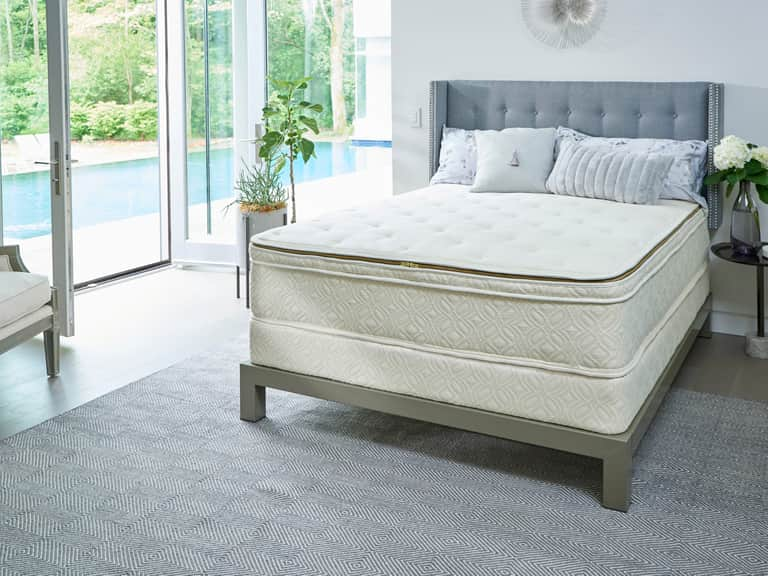
For a contemporary point of reference, The Clean Bedroom provides information about products that foreground organic and natural materials. Its Naturepedic Elysium Hybrid Organic Mattress, for example, is described as combining organic Dunlop latex and wrapped coils with a quilted cover and a natural-fiber layer containing wool, alpaca, and cashmere. It illustrates how current bedding can bring multiple materials together in a single construction. The product is not a direct continuation of a feather tick, but it offers a useful contrast: the old mattress depended on a comparatively simple casing and filling, while a modern hybrid mattress is an engineered assembly of distinct components.
When considering such claims, readers can distinguish between what a product description states and what a certification independently verifies. Terms such as “organic,” “natural,” and “sustainable” may be used in different ways, so shoppers benefit from checking the scope of any certification and the exact materials listed. The most useful question is not simply whether a bed is natural or modern, but how its parts are made, how they work together, and how long they are expected to remain useful.
Comfort, health, and changing expectations
Ideas about a good night’s sleep have changed alongside the objects used to achieve it. In earlier households, warmth, dryness, and a clean covering could be central concerns, particularly when rooms were difficult to heat or crowded. Later, advertising and consumer culture increasingly emphasized softness, support, hygiene, and specialized comfort. Today, people may also ask about allergens, chemical finishes, certifications, or environmental consequences.
These concerns should be approached thoughtfully. A bedding material by itself does not guarantee better sleep or a particular health outcome. Comfort is personal and influenced by many factors, including temperature, support, room conditions, and individual needs. For health questions, product descriptions are not substitutes for professional advice. Historical perspective can help separate long-standing household practices from modern marketing language, but it cannot establish that one material is best for every sleeper.
What has changed most clearly is the range of information available to consumers. A buyer may now compare fiber content, manufacturing details, certifications, and construction before choosing a mattress. That degree of scrutiny would have been unfamiliar to many households that relied on local materials and domestic skill. Yet the underlying impulse—to make a bed comfortable, dependable, and appropriate to the household—has endured.
How to investigate a family bed’s history
For anyone researching Missouri household history, bedding offers a practical route into broader questions. Start with the object, if one survives. Examine its seams, fabric, repairs, labels, and construction without assuming that appearance alone establishes its age or origin. Museum staff or textile conservators can advise on safe handling, since fragile fibers may be damaged by cleaning, folding, or prolonged exposure to light.
Next, look for documentary traces. Census records can help establish a household’s location and composition but rarely describe its bedding. Probate inventories, account books, letters, and local advertisements may offer more direct evidence. Newspapers can show how stores marketed mattresses or textiles, while trade directories and business records may identify local manufacturers and retailers. Each source answers a different question; none should be expected to provide a complete account on its own.
It is also useful to compare evidence across time and place. A mattress described in a household inventory may not have been made locally, and a surviving quilt may have traveled with a family during migration. Missouri households were shaped by movement within the state and connections beyond it. Materials could arrive through commerce, migration, inheritance, or exchange, making the bed a quiet record of relationships between home and wider world.
Finally, keep uncertainty visible. “Feather bed” may refer to a particular kind of filled mattress or bedding layer, depending on context. A record that says “cotton bed” may not clarify whether cotton was the filling, the ticking, or another part of the assembly. Rather than filling gaps with assumptions, researchers can note what is known, what is likely, and what remains unanswered. That careful method makes ordinary objects more—not less—interesting.
A history still being made
The path from feather ticking to organic cotton is not a simple replacement story. Materials overlapped, returned, and adapted. Feathers did not vanish when manufactured mattresses became common; cotton did not become the only natural choice; and modern bedding can combine fibers and mechanisms that earlier makers would not have recognized. Each era inherited some habits from the last while introducing new tools, markets, and ideas of comfort.
For Missouri, this is a history best understood at household scale as well as through larger changes in agriculture and industry. A quilt in a family trunk, an entry in an estate record, or a mattress specification in a modern product description can each reveal different ways people have thought about sleep. The evidence may be humble, but its reach is broad: it connects domestic work to regional commerce, material culture to technology, and private rest to public histories of production.
Today’s attention to organic cotton and other natural fibers echoes an old awareness that what goes into a bed matters. The questions have changed in detail, but the practical concerns remain familiar: Is the bed comfortable? Will it last? Can it be cared for? What resources and labor went into making it? In answering them, we can see the bed not as a fixed piece of furniture, but as a small landscape of changing materials and values—one that Missouri households, like households everywhere, continue to remake.
A short guide to sleep-material terms
- Ticking: A durable woven fabric used to enclose mattress or pillow filling.
- Feather tick: A filled bedding item with a closely woven casing intended to contain feathers or similar filling.
- Natural fiber: A broad category that includes plant- and animal-derived fibers; the phrase alone does not specify how a material was produced.
- Organic cotton: Cotton grown and processed under defined organic standards. Certification details and scope vary, so consumers should check the claim and certifier.
- Hybrid mattress: A mattress combining different support or comfort components, such as coils and foam or latex layers.